Showing posts with label Olympic NP. Show all posts

Saturday, December 6, 2014

Thanksgiving 2014: Olympic National Park & Ridgefield

Of Birds and Dams

November 26, 2014


The Wednesday before Thanksgiving had me waking up to a very wet morning at the Elwha Campground in Olympic National Park.  Before heading down to Salem for the family gathering I had three stops to make.  First, I wanted to see where the upper dam had been removed on the Elwha River.  Second, I wanted to see the view from Hurricane Ridge.  Last, I wanted to make a stop at Ridgefield National Wildlife Refuge to see the birds on the auto tour.  That would be another full day on this trip.

Elwha River, Olympic National Park, WA
Elwha River
The Elwha River story is an exciting one for environmentalists and nature lovers.  In 2012, two dams were removed from the Elwha, freeing up the river to run unfettered from its headwaters in the Olympic Range to the Strait of Juan de Fuca.  Apparently salmon and trout have already returned to waters where they haven't been seen in one hundred years.  See, exciting, right?

It's going to take some time for the river to recover from the damage done by the dams.  One hundred years of silt deposits have built up behind the dams.  The Elwha was gray the day I visited, not from the overcast sky but from all the silt in the water.  It was very reminiscent of how the rivers looked after Mt. St. Helens blew its top.  The river was running pretty high, but what shoreline could be seen was covered in gray mud.  This shifting of soil is an important aspect of a river's role in the ecosystem.  The Colorado River used to be known for its muddy waters before it was dammed, and one of the many negative impacts of the damming of that river has been the loss of sandy beaches in the Grand Canyon.  Large runoffs are now being implemented occasionally in part to try to build those beaches back up, but on the Elwha the solution of simply removing the dams seems like the more straight-forward solution.

Elwha River, Olympic National Park, WA
I guess I'm more of a nature lover than an environmentalist.  I am ecstatic about what's happened with the Elwha and a few other rivers that have been recently freed of their dams, but I also recognize that some dams are important to our current society.  As much as I would love to see the Bonneville, Hoover and O'Shaughnessy dams removed, how would the power and water the dams and their reservoirs provide be replaced?  Mind you, I hope to see it in my lifetime, but I suspect I won't and that's the price we pay for our urban electronic lifestyles.  I do hope, however, that this is a harbinger of a new movement to rid our lands of each and every dam that we can find a way to live without.  I suspect that we only need a fraction of the hundreds of dams that exist today.  Actually, I suspect we can find a way to live without any of them, but it will take decades to sort that out, if we ever do.  For now, I'll be happy with each individual victory, like what we've seen on the Elwha and what I hear is coming to the Klamath, where four dams are planned for removal to restore that wonderful river to its former glory.

Elwha River (formerly Lake Mills), Olympic National Park, WA
I drove up to see the remains of the Glines Canyon Dam (just out of frame to the left in the above photo).  I enjoyed the stunning view, but the irony wasn't lost on me that this view won't even be possible once the damage done by the dam has been corrected.  This hillside will be covered in trees that obscure what I'm sure will one day be a shoreline of dense forest, the bends in the river and the view itself blocked by tall trees.

Elwha River, Olympic National Park, WA
Before leaving the Elwha River Valley, I made a short hike up to Madison Falls.  It's a nice little waterfall in a lush forest setting.  It was a nice little detour before heading up to Hurricane Ridge.

Madison Falls, Olympic National Park, WA
It turned out that I wouldn't make it up to Hurricane Ridge, the road was closed for the winter.  Doh.  I drove up as far as I could hoping to at least get a few photos from higher ground, but I didn't end up with anything worth keeping.  So, I headed back down 101 on the East side of the Olympic Peninsula toward Olympia, where 101 ends by merging into I-5 South.  I love the fact that 101 ends in a Southerly direction after having driven it for a thousand miles North.  How many highways do that?

The Olympic Range, Port Angeles, WA
The East side of the peninsula has proven to be a great stretch for me for seeing bald eagles.  They seem to like the shoreline of Hood Canal which 101 also happens to run down.  This year I caught three bald eagles flying around over the highway, they seemed to just be horsing around.

Bald Eagle -- Lilliwaup, WA
I made it to Ridgefield at about 3:00.  That would give me enough time for the auto tour, but I wouldn't be able to do any hiking.

Ridgefield National Wildlife Refuge, WA
Aside from hosting a lot of bird life at various times of the year, Ridgefield is an area of scenic beauty.  That's not always the case.  While the central valley reserves have their moments, for the most part I spend my time there shooting animals with my 250mm lens hoping the backgrounds won't be too ugly.  At Ridgefield, my wide angle lens gets almost as much use as the 250.

Ridgefield National Wildlife Refuge, WA
Northern Shoveler
I took a lot of photos of wildlife, but the is the light just wasn't very good for close ups.  I found myself having to choose between blurry shots with little ISO or grainy shots with a lot of ISO.  My wide angle seemed to be enjoying the challenging light situations, though, so I ended up with a lot more interesting broad shots than close ups of birds and nutria.  I'm not complaining, I love what this 17-40mm lens can do.

Ridgefield National Wildlife Refuge, WA
I drove straight down to Salem after the auto tour.  Thanksgiving, after all, was just around the corner.


Wednesday, December 3, 2014

Thanksgiving 2014: Olympic National Park

Revisiting Olympic

November 25, 2014


Soundtrack:

  • David Bowie -- The Next Day
  • Arcade Fire -- Reflektor

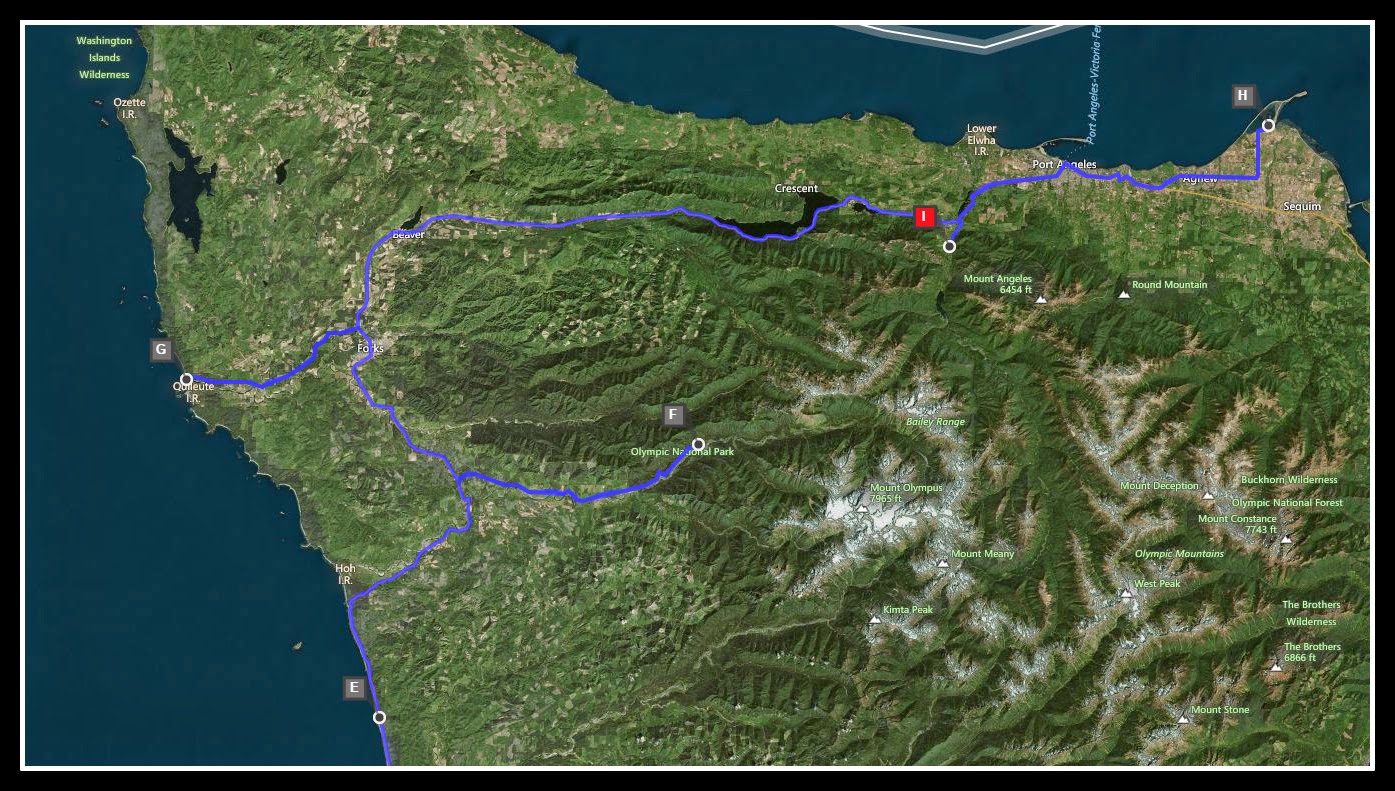
I spent Tuesday at Olympic National Park revisiting a lot of the same places I went last year.  I had hoped to be able to get out on foot and explore a bit more, but the rain kept coming so I wasn't able to do much other than drive from place to place and get out on short walks for pictures.  That's OK, it was still an enjoyable day.

Ruby Beach, Olympic National Park, WA
The first stop was Ruby Beach.  It's shores are lined with rocks rather than sand, more like a river in that sense.  A river doesn't have the sort of driftwood deposits that Ruby Beach has, though.  I'd love to explore the beach heading North but that direction is blocked by a large creek this time of year.  I was talking to a woman on the beach and she said there's some interesting sights in that direction.  Perhaps I'll be here at some point when the creek isn't so strong and I'll be able to explore a bit more.

Ruby Beach, Olympic National Park, WA
Next, I drove up into the Hoh Rainforest.  The rainforest is about twenty miles inland from Highway 101.  It's a beautiful drive, much of it following the bank of the Hoh River.  I really like that drive and would love to take a kayak trip down the river.  Another something for another day.

Hoh Rainforest, Olympic National Park, WA
I mentioned clear cutting in an earlier post, and I'll mention it here to because the impact here is potentially devastating.  Most of the drive into the rainforest takes place on land that isn't protected by the National Park.  The picture above, for instance, isn't actually in the park, but on the road leading into the central park of the park.  Olympic National Park isn't one contiguous parcel of land, it's made up of a few pieces, the largest being the center of the Olympic Peninsula.  The border of the Park is ten miles or so from Highway 101, which runs along the border of the coastal portion of the park.  Sections of the forest between 101 and the park are eligible for logging, and in fact less than a mile from where I took the photo above a large section has been clear cut.  It saddens me to think that a forest this scenic is being destroyed for the sake of plywood and two-by-fours.  I'd love to see this land between the coast and interior regions annexed into the park.  This place is special and deserves our protection.  The problem, of course, is that I'm sure it would displace some people, or at least alter the lifestyles of the people that already live there.  There are never easy answers, are there?

Hoh Rainforest, Olympic National Park, WA
Hoh River, Olympic National Park, WA
My next stop was at Rialto Beach, which is evidently deep in the heart of Twilight country.  There are even signs warning of the dangers of vampires in the forest.  Kind of fun, if you ask me.  I've seen a couple of the movies, they're not so great, but they do show an appreciation for the beauty of this part of the country, so I wouldn't say they're worthless by any stretch.

Rialto Beach, Olympic National Park, WA
Rialto Beach has an even more impressive assortment of driftwood than Ruby Beach.  There are some truly immense tree trunks lining the shores of this beach.  I even saw a couple of logs in the surf on this particular visit.  The power of the ocean is quite evident here, making this a particularly dramatic place to visit.

Rialto Beach, Olympic National Park, WA
Colombian Black-tailed Deer
My final stop before finding a campsite was at Dungeness National Wildlife Refuge.  I didn't see a whole lot of wildlife there aside from a few pacific wrens, a northern harrier and a couple of deer.  It turns out most of the interesting wildlife is two to six miles out on a sand spit in the Strait of Juan de Fuca.  I didn't have time to hike out there, unfortunately, having arrived at the refuge with about an hour of light left.  Yet another thing I'll have to chalk up for another day.  I really need to spend a week or so out here on the peninsula.

Dungeness National Wildlife Refuge, WA
I camped for the night at the Elwha Campground near the bank of the Elwha River.  Much like the previous night, there were only a couple of other campers around.  It didn't rain as much that night, though, so I was able to relax outside by the fire in the evening with whisky and a cigar.  That was a nice end to a wet but enjoyable day.

Elwha Campground, Olympic National Park, WA


Monday, December 1, 2014

Thanksgiving 2014: Crossing the Columbia

Crossing the Columbia

November 24, 2014


Soundtrack:

  • The National -- Trouble Will Find Me
  • Steve Martin & Edie Brickell -- Love Has Come for You
Lincoln City, OR to Kalaloch Lodge, WA on Highway 101 is an incredible stretch of road.  Some of it borders the ocean, but most of it is inland a bit.  It's two hundred fifty miles of rain forests, marsh, rivers and wetlands, with the biggest towns along the way being Astoria and Aberdeen, homes of The Goonies and Nirvana.


Garibaldi, OR
Tillamook Bay, OR
The little town of Wheeler sits on Nehalem Bay.  It looks like a good place to do some kayaking.  I'm making a note of it for my next trip up the coast.

Nehalem Bay, OR
Nehalem Bay, OR
Nehalem Bay, OR
Manzanita, OR
I stopped at Cannon Beach for a closer look at their Haystack Rock.  Pacific City also has a Haystack Rock.  After careful consideration I've decided Pacific City's Haystack Rock is the real one.  Cannon Beach is going to have to change the name of their big rock.  I propose Big-Assed Rock as the new name.  I'm sure they'll be getting right on that.

Cannon Beach, OR
Crossing the Columbia in Astoria is something I look forward to on the 101 drives.  That bridge is so iconic to me, and the mouth of the Columbia is extraordinarily wide at that point.  Granted, it's not as pretty the Golden Gate Bridge or the Newport Bridge (does that one have a name?), but it might be my favorite bridge on 101.  Well, you know, after the Golden Gate Bridge and the Newport Bridge (or whatever it's actually called).

Willapa National Wildlife Refuge, WA
I blew through the Oregon portion of the drive because I wanted to spend some time at Willapa National Wildlife Refuge in Washington.  Turns out, most of the refuge is only accessible by boat.  So much for that idea.  There's a nice little interpretive art trail next to the visitor's center.  It's a short walk on a curvy wooden platform through a little section of the reserve next to the parking lot.  It was nice, but I'd been hoping to see some wildlife.  No such luck, at least not without a boat.

Willapa National Wildlife Refuge, WA
I usually look for nice scenery to display on this blog, but there's a lot of clear-cutting along 101 in Washington that still goes on today.  Logging in general isn't what it used to be in Oregon, so I don't tend to see it there and I think clear-cutting is illegal now in California.  I'd sure like to see Washington enforce selective logging as the only option for the timber companies.  I'm sure it's not as cost effective as clear cutting, but the lower impact on the environment should be the primary consideration if you ask me.  Obviously, as an occasional tourist I don't have much of an investment in this issue.  I just hate seeing what clear cutting does to the land, which takes decades to recover.  Come on, Washington, how about it?

Clear cut forest along Highway 101, WA
I stopped to photograph some geese somewhere along the highway.  They suddenly took off all together, honking and flapping as only geese can do.  I thought I'd startled them, but then a bald eagle buzzed them and I was off the hook.  That eagle joined a couple of others and flew off into the hills.


Canada Goose -- Highway 101, WA
I reached Kalaloch before dark.  It was raining pretty hard but I was able to find a campground that was fairly well covered by trees, so I set up camp for the night.  It got dark quickly, so I made a fire, ate dinner and had a drink.  It was still a little early, but I was tired so I decided to call it a night.  I was just falling asleep when my wife called me.  She though I was drunk, but I told her I'd only had one drink (true) and was falling asleep.  She laughed and asked me if I knew what time it was.  It was 6:30.  It didn't matter, I went back to sleep after the call and didn't wake up until 8:00 the next morning.  Yeah, I guess I was tired.

Kalaloch Lodge, Olympic National Park, WA